Thursday, 17 April 2014

Rozy.

I started to write this post on a Eurostar train when I was not in the mood to read and M, my travelling companion, kept himself busy with a comedy show on the ipad. I was wearing Rozy which I had been introduced to just two days earlier at an evening at Bloom perfumery in East London. For a full report on the evening and the wonderful and inspirational Vero Kern please read the post by Tara on Olfactoria's travels.


Vero Kern at Bloom perfumery
Being immediately drawn to this mysterious scent I decided to spend the train journey to Paris wearing it. The fragrance was so present that it felt like carrying another soul with me, an invisible traveller, if you like. I began writing random words and associations, trying to unfold and dissect the perfume's soul possessing nature when I realised that a lot of the vocabulary in my notes stemmed from the magical and the drug related. Intoxicating, mind altering, possessive, psychedelic, bewitching... 
No coincidence, given how closely connected these two worlds are. It's a very small step from the love potions and ointments of medieval witches to Timothy Learie's LSD experiments. And if we still lived in the Middle Ages, I am sure that our modern perfumers would be accused of witchcraft. The women amongst them foremost and anyway. Not much danger to end up on the pyres when you produce a fragrance that just smells a bit nice, but if your creation is as potent and beautiful as rozy in its voile d'extrait form, you might be in trouble. Of course I'm not suggesting here that Vero Kern is a modern witch, I merely want to give an idea of the power her scents possess. So, back to the rozy, which at that stage (about 2 hours in) had developed to its full potential, and I had been thoroughly hexed by scent. 


My visual interpretation of rozy. in voile d'extrait by vero.profumo

At the event Vero told us that her inspiration for rozy had been the magnificent Anna Magnani in the film Rose Tattoo. And of course, having just reviewed another perfume dedicated to her, Nobile 1942's Chypre, I am now most intrigued about comparing  them. There are undoubtly  hues to both scents that show them to be in a colour family of golden yellows, burnt oranges, rosy reds and some brown, but the overall effect is very different. Chypre is less vibrant and multifaceted but gentler, more a hearty home cooked dish compared to rozy's finesse. By this I don't want to diminish the Nobile scent, it's just a different approach to a similar theme but there is no denying that vero.profumo's creations are in a league on their own. 

When M saw me working on the visual for rozy he said:" Oh, that looks like a maelstrom of roses." and he was right, I wanted to capture the perfume's amazing ability to take you and your soul on a mind altering ride where it's not you, the wearer, who is in control. An oriental rose glazed in aromatic honey. Tuberose, but thankfully not too much of it, balsamic labdanum, vanilla, cassis and sandalwood. The mere notes never explain the effect of the whole melange coming together. In this case, it's a mixture that is both unsettling and comforting. How that is achieved with such quality and opulence I have absolutely no idea, but given that Vero Kern is also a trained aromatherapist, it's safe to say she knows her stuff.  It is not an easy scent for me though. For all its beauty, I simply have to be in the mood to be that much entranced. When I was wearing it in the relative closed environment of the train I got almost a bit scared by it. Rozy doesn't just sit on my skin and dries away, it dances. It has an excellent sillage but manages not to overpower an entire train carriage (just me) and stays forever on my perfume eating skin. I found a trace of it the next morning. If you like the general description of the notes, (don't be scare off if any of them is usually not to your liking, it's all in the mix) and want to have a perfume like no other, rozy in the Voile d'Extrait concentration is a must try. I find it truly magical. 


How and where to wear:
If you're not afraid to wear something that goes on and under your skin then rozy will make excellent company.


An explanatory note: This review is based on 
a.) rozy in voile d'extrait concentration, there is also an EdP version which is a bit greener and has peach and mint instead of the cassis, as far as I remember.

b.) a sample given to me by Bloom perfumery at the end of an event for which I paid.


Wednesday, 2 April 2014

Friends reunited, The Perfume

Our 20's should, in theory, be years of youthful joy, optimism, and independence. Mystified as a glorious time for trying out everything before finding yourself, for many of us they turn out to be the most miserable years we are going to have this side of 50. Quarter life crisis is a relatively new concept and it sounds ridiculously silly and self indulgent. Even though the idea was virtually unheard of during the 80's, I suffered badly from it. With extra hairspray and bells on. 

I had left home for art school at 19 with a wardrobe full of hand-knitted jumpers, floating dresses, a ton of books and all the enthusiasm in the world, and within a year I had bottle bleached hair, mostly black clothes and a big identity crisis. Although I was living in a sleepy and rather beautiful small German spa town I wanted to to be part of the 80's unprecedented urge for the ultimate Cool with a capital C. Like many others before and after me, I spent my student years trying too hard to fit in with the New and was shamefully fast with getting rid of the Old. Ultimately, it didn't make me a happy young woman. Living on my own was an exciting and new experience, but it was also far more stressful than I dared to admit and pretending to be cool with everything and making decisions that would have great impact on the rest of my life was a little bit more than I had bargained for. At a time when even banal wardrobe decisions could make or break your peer group status it was good to have a few corners of your life that were uncontroversially simple. In one of those corners were my books, and in another was perfume. I had a little treasured collection of smelly things, mostly hippy-shop essential oils and lots of incense sticks, but also perfume bottles gifted to me by my mum or my granny. Often these "young women scents", like Charlie and Anais Anais  were overly floral and/or too clean for my tastes, but then came the 80's Big Perfume Bang. Everyone was wearing something, and lots of it! And because my mum had a good idea of what I liked she usually gifted me a bottle for Christmas. Karl Lagerfeld, Salvador Dali and Montana Parfum de Peau were amongst my precious possessions, but my signature scent in the late 80's was Jean Louis Scherrer No. 2. I loved the Art Deco inspired bottle and its slightly understated content. For the time JLS2  was probably a bit too subtle, nothing in this perfume shouted "Wham!", but it suited me, or better said, it suited the image I had of myself. 


I wore it for a decade and it was only when a man complained about my "old fashioned" perfume choices that I gradually gave it up. I know, should have given up the man instead, and not just for olfactorial disagreements. The late 90's and early 00's didn't do it for me perfume wise, and I felt that I was out of touch with what was considered a modern scent. Giving it up all together was a safer and easier option. 


Ever since my love for perfume has returned I wanted to go back to the Scherrer and see what it would evoke after all these years, but it had never been popular here in the UK and wasn't easy to find in the shops. Last autumn when I visited the little Jean Patou boutique in Paris I eventually had a chance. (Patou and Scherrer are now owned by the same British company based in glamourous Watford). I cannot say it instantly gave me imaginary shoulder pads, but it was a pleasant reunion with an old acquaintance. Pleasant enough to start looking for it on amazon and ebay. 
Last week I got lucky and for a little over a tenner it became part of my collection. I only ever owned the EdT and this is an EdP version of unknown age, but it feels sufficiently like the scent I remember. I know it has been reformulated to fit in with EU regulations and it's certainly cleaner than it used to be, but quite frankly, it's been 20 years and I've changed more than a bit as well, so I will not go into a hissy fit about it. Life goes on, we change, we get old if we're lucky, and discontinued if we're not.   
The opening is an aldehydic equivalent of big, backcombed hair, followed by tons of honey, some rose, some orris and a few drops of fruit juice and amber. This is what I can actually smell. When I looked it up online a dozen notes that I didn't notice showed up. Some of them are real pet hates of mine, like the evil peach, and in this case I'm grateful that my nose isn't detecting them. Analysing this perfume with its connection to my younger self is difficult at any rate, I simply cannot detach myself enough and whenever I try to, it muddles my brain and plays tricks with me. It has excellent sillage and I feel properly dressed when wearing it. Despite the ingredients it's never been a sweet scent for me. Warm, yes, but not sweet. Stays on for at least 6 hours and turns its golden hues into a dark orange towards the end. It comforted and hugged me then and is still lovely to me now, like a friend who has forgiven me for losing touch and happy to catch up again whenever we feel like it. I've tried hard to do a visual, but in the end I went for a picture of me trying hard to be cool in the 80's. I might have worn the scent on the day the photo was taken. 


How and where to wear:

I would like to wear this in 30 years time when they play KISS  for afternoon tea entertainment at retirement home. Hope my joints will still allow for some moves on the dance floor then.


Wednesday, 26 March 2014

What's in a name? Chypre by Nobile 1942

There are probably 12345 perfumes out there which I could potentially fall in love with, but time, availability, Royal Mail postal restriction nonsense and money are issues that regulate the amount of scents I can possibly try. Never mind review. But it's difficult to resist ordering this set and those samples,  and in the end it's inevitable that I sometimes  lose track of what's hiding in my little Poundshop drawers. My organising system is simple enough though: 

 A  to  Z


Some letters seem to attract far more little vials than others, F and G for example, are not very popular, but exploring the Hows and Whys of that is something that I leave for another post. A to Z is easy but not very helpful if you just want to try something floral/woody or hesperidy/green and have forgotten the main notes for the better half of your sample collection. So it's really handy when a perfume house is helpful and names things in a simple, matter of factly way. Like  C is for Chypre. In the second drawer from the top, labelled B and C with these slightly tacky, red glitter letter stickers from yet another Poundshop. I was in the mood for a chypre and it couldn't have been easier. Chypre by Nobile 1942 it was...


My visual interpretation of Chypre by nobile 1942


As far as I know the Italian perfume house Nobile 1942 isn't in the business of giving deliberately misleading names to their creations in the way that LeLabo do, but is this really a chypre?
Yes, it has a fresh bergamot and mandarin/orange opening, but on my skin there is very early on a pinkish bright bubblegum note that makes me smile and reminds me of the effect that Tuberose No.1 had on me. Just the right amount of that difficult note, not too overpowering, just coming to say Hello a few times during the earlier dry down. Love it! I know my skin has the tendency to wolf down the citrussy notes and whatever sweetness a perfume might possess often becomes weirdly exaggerated, but this perfume is still a bit of a surprise. A very nice one though. It's classy, just a tiny bit old school, but incredibly wearable. After about 2 hours it does get a bit closer to a traditional  chypre with the neat hovering between a fresh green and a bed of flowers, mostly roses with a patchouly hint. I would call this phase floral chypre.  It transcends into a comforting vanilla wood after a long day of wearing and I still got a whiff from time to time when I was laying in bed. Projection is not all that great, considering. M. declared it a skin scent verging on the masculine, but I strongly disagree. Yes, it does stay close to skin, but there is no doubt about it's gender. For me Chypre is a very feminine perfume. It covers the sensual and the imaginary in equal terms, but it always stays on the double x- chromosone side of things. For my visual interpretation I wanted to capture it's radiating warmth and "earthyness", no hard lines but not too ethereal. The right balance of colours  was the easy bit but to find the overall texture of the visual turned out to be really difficult. I struggled all day with it, trying out lots of things and I was close to leave it, at least for a while, when I found a solution that is close enough to my idea of the scent to publish it, but may be I will change it again in future.

And in the end I don't care what the name of this beautiful scent suggests, but I do want to know a bit more about it's story. It's dedicated to iconic Italian actress Anna Magnani. Award winning figure head of Italian Neo-Realism, unusual beauty, strong minded she was a woman of considerable strength and charisma, never mind talent. I can't possibly  know if the perfume would have suited her, but the image I have of her totally suits the perfume. She is a wonderful example of a passionate and confident woman who doesn't give a damn, whose laughter is smokey and a bit dirty and who does what she wants without any false pretence. Inspirations for perfumes don't come much better than that and while I thought for a while that calling it after her would have been a good idea, I'm not so sure anymore now, because after all: What's in a name anyway?

Have a look at this video showing Anna Magnani in Pier Paolo Pasolini's film 
Mamma Roma from 1962. 


How and where to wear it:

Inspired by the video, no doubt, I'd say: Late summer evening with friends and family, lots of wine, lots of laughter, lots of home made hearty food, at ease with yourself and the world

Thursday, 13 March 2014

Gothic Bluebell, come celebrate Spring!

We didn't have much of a winter here in the UK, it basically rained, and then it rained a bit more, followed by some rain...But that doesn't mean that we're not super excited about the first signs of spring.
You can already see some weirdos in flip flops and shorts, the magnolias show the first blooms and the shops are in full Easter decoration frenzy with their happy go lucky depiction of spring in sugary pastels, bright yellows and fresh greens, sometimes verging on the psychedelic. Yes, those are the colours that come out in spring, but the season is so much more powerful and dramatic then fluffy bunnies and eiderdown chicks in teletubby land. It's about the reviving, mating, growing and reproduction, isn't it? 

Although I'm not all that seasonal in my perfume wearing, the beginning of spring and autumn are both times when I am excited about change and this will manifest itself in my wardrobe and perfume choices. Right now I want something more green and floral, but I'm not yet ready for the full flower bouquet. And while I'm always happy to try out new fragrances, my main choices for this spring have been made. It's going to be Aedes de Venusta's signature scent of which I have a 10ml that will last me for a while and then I  simply have to buy a bottle of Gothic Bluebell by Union fragrances.
Why? Well, the Aedes has this delightful fresh sparkle of rhubarb that feels just right for the moment and the Bluebell is a veritable feast of hyacinth, violets and damp moss.


My colour interpretation of Gothic Bluebell by Union

When you go walking in a British forest during the bluebell season you might stumble upon one of those incredible carpets of purple and blue, kissed by sunlight and flanked by the darkness of still bare trees. It's a truly memorable sight and so surreal in its unexpected beauty that you can imagine elves and fairies passing by at any moment. These little wild flowers produce an abundance of colour and scent and half of the world's bluebells can be found in the UK, so they're pretty much a national treasure. (Sadly under threat from the scentless but more robust Spanish bluebell plants). 
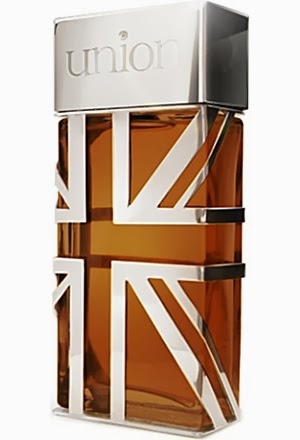
Union fragrances is obviously a very patriotic British perfume house, celebrating the aromas of the British Isles in all their glory. Just look at their bottles:

The idea behind Union is to use as many homegrown ingredients as possible and recreate different aspects of the unique British flora. Their fragrances carry names like Holy Thistle, Celtic Fire and... Gothic Bluebell. A rather fitting name I find. I fell hard for its mysterious and sweet beauty, but I guess it's actually not that easy a perfume to love or like. Hyacinths and violets, used here to enhance the bluebell effect, are both notes that can be an required taste, suffering from being labelled old fashioned and granny-ish. This fragrance is certainly not very urban or contemporary, but I would call it ancient and Pagan rather than old. The innocent powdery notes associated with pastel colours are combined with a woody and animalistic accord that gives this sweet scent its darker woody aspect. Instead of taking the delicate floral notes on a road trip to modernity it decides not to bother with being cool and follows hidden and ancient paths where the trees are casting long and twisted shadows and the light is eerieand ethereal. I used this image as the inspiration for my colour interpretation which had to feature lots of purple, some white, a hint of green and a dark shadowy hue in the background. When I first wore Gothic Bluebell it immediately reminded me of Pre Raphaelite paintings - another very British affair - where danger always seems just a second away from all the twee-ness, the whimsy and the Kitsch. Beautiful women in medieval costumes brush their long hair whilst humming a simple melody and suddenly some brute jumps out at them and slits their throats....or something along these lines.


Ophelia by John William Waterhouse, 1889


Gothic Bluebell has a powerful sillage and stays with me all day, although it doesn't change much, keeps its main notes until the end and fades out very gently. It's incredibly intoxicating and sexy in a refreshingly unsophisticated "Come and Shag me" sort of way. Sometimes beauty doesn't need much finesse but presence, and Gothic Bluebells certainly has that in abundance. 


How and where to wear:

As Beltane has gone out of fashion a dozen centuries ago I suggest its modern day equivalent, the Internet dating. Wear it while composing your profile and feel irresistible.


Images via Union Fragrances website 
and wikipedia

Thursday, 20 February 2014

The Gentleman and the Lady

When I sit in my little office I look at a wall of souvenirs. Postcards, labels, business cards, little notes, photos of cats and people, tickets and other oddities which I find interesting. One of the items is a postcard from an art exhibition I visited in Paris last October, showing "Box seats at the theatre, The Gentleman and the Lady", by Swiss painter and print maker Felix Vallotton

Although not really his most famous work, it was the image the curators of the Paris exhibition had chosen to advertise the exhibition all over Paris, and it attracted me to go and see it. I had no real idea what to expect other than seeing the work of a late 19th, early 20th century's painter of mediocre fame. The exhibition held a vast amount of artworks, varying from slightly surreal and beautifully stylised landscapes to portraits, nudes of debatable quality, fantastic black and white wood prints, horrendous illustrations of classical and biblical themes and a few absolutely astonishing paintings of genre scenes, often showing couples. I walked around being surprised that one man had managed to create art with such difference in quality and craftsmanship. His wood prints in particular were outstanding, and he has obviously been very influential for Aubrey Beardsley. And on the other hand he produced some truly awful female nudes that make you wonder if some adolescent wannabe painter had been temporarily given the reign over the canvas. But whenever the women in his art have their clothes on they are interesting and as a spectator I want to know more about them and their story. 
A particularly weird nude from Vallotton
Example of Vallotton's wood cuts


Box Seats at the theatre, the Gentleman and the Lady by Felix Vallotton, 1909


The decision to chose The Gentleman and the Lady as the icon of the exhibition was clearly an inspired one, and having since spent 4 months with the image in front of me, it hasn't lost any of its enigmatic power, despite it's somewhat shoddy technical finesse.  What is the story behind this couple surrounded by darkness, he in hiding, almost trying not to be seen and she looking forlorn and lonely, overshadowed by her enormous hat. The balcony belongs to the theatre or the opera, but wherever they are, he seems to be watching her, not anything on stage. They are very much in a public space, yet obscured by darkness. However glamourous and joyous the perfomance might be, it doesn't reach up to the Box seats. There is a lot of sadness in this painting and a weird dangerous undertone is humming in the background. Is she a "kept" woman and he married to another? What is she thinking? What perfume might she wear? Something he bought for her? To answer that last question in a lazy sort of way I could just go back in perfume history and chose one of the early Guerlains, or a Penhaligon,  but I'm not really familiar with vintage scents, and I'm sure there will be a contemporary fragrance out there that feels right for her. 

I think it should be something with a hint of powdery, old fashioned toiletries. But as she is the dominant figure in the painting, her scent will also have a strong attitude. Something that announces its presence, but not giving away all its secrets all at once, and then only to the person coming close enough to smell it on skin. Hm...
Lipstick Rose from Frederic Malle comes to mind. As does Moulin Rouge from Histoires de Parfums. It's been a while since I had last smelled Lipstick Rose, so today I made a detour to Liberty to get - not a sample - but a sealed piece of paper. ( I know they have samples, they know they have samples, but we sort of both pretend they don't exist. Does my head in, but is another story...) So back home with LR both on paper and on skin I have to say that although it fits the criteria of "old fashioned make up" it is far to bright and happy go lucky in colour. The memories condensed in this fragrance are happy ones and  the painting is gloomy, its hues subdued and earthy.  My other idea fairs much better. From the start Moulin Rouge is actually a bit "muffig". This neat German word describes a variety of slightly unpleasant smells, ranging from damp to stale. Moulin Rouge is a bit rank, but not too much, just on the right side of  "times gone by". It feels alltogether like a scent that has captured something that has disappeared. If you think of the Nicole Kidman Moulin Rouge of the musical/movie with its plush colours and overbearing decor you are in the right place but wrong time for this perfume. This Moulin Rouge is a bit haunted, the carpets and velvet curtains are fading and the music has long long gone. But the Histoires de Parfums creation is much better than I make it sound. After about an hour I do get powdery sweetness, and warmth, a bit waxy, with some dryness that, for me, speaks of the empty stage and a dusty red curtain that will never be lifted again. It's a lovely scent that stays close to skin, with hints of red roses and pale iris, but ultimately this theatre backstage smell is not mine. It is, however, a fantastic time machine sort of fragrance, and from now on the perfume I imagine the sad Lady in Vallotton's painting to be wearing whenever I look at her.

This is in a way, the second artwork meets perfume post on this blog, and I am planning to make that an irregular feature. Because I don't really think of these posts as proper reviews, more like inspiried musings, I will not do  a Where and How to wear for those. Just doesn't feel right. But if the artwork speaks to you, you might also like my chosen perfume.  


And now: Off  to Thailand.


Monday, 10 February 2014

Aleksandr

When I reviewed Jardins d'Armide from Oriza L.Legrand the other week I mentioned that I really would like to see the house move from the recreation of historic fragrances to telling "old"  stories with a contemporary twist. And then chance will have it and I find someone else who is doing exactly that. Three weeks ago I attended a perfume event at Bloom perfumery in Spitalfields, where Carlos Huber, the founder of Arquiste perfumes presented and explained his fragrance line. Unfortunately I managed to arrive a whopping 30 minutes late (thank you number 78 bus, thank you apple maps, thank you stupid no sense of orientation brain) which was a real shame because not only did Carlos explain  a lot  about the  inspirations behind scents but  he also gave us the opportunity to have a sniff at the single ingredients he used. I entered the shop just in time to hear him talking about Aleksandr, the perfume inspired by the rather tragic story of Russian poet Aleksandr Pushkin. It is told in notes of:
Violet leaves
Vodka
Leather
Fir balm
Smelling the violet leaves was a bit of a revelation - no sweetness, no pastell colour, but a strong earthy green with quite some punch. Not unpleasant, but a bit in your face. Carlos explained that he used that particular note for the earthyness but also because it does have that old fashioned powdery perfume element. Perfumes did smell of violets at that time. The next note, vodka, or alcohol in general makes a lot of sense in terms of telling the story of a Russian poet of the 19th century, but this particular poison is famed for its non-smelling properties. On my little paper strip I detected just a hint of fizzy freshness, more like a vodka/champagne cocktail than the pure thing. 
And then the dominant note, the leather. The essence we smelled was of the finest quality boot leather. Not a feminine suede glove, but polished black riding boots. I am a bit of a sucker for 19th century men's costumes. High boots over tight trousers, what's not to like?
The final note, the fir balm, hinting at a forest touched by a misty morning fog, (the perfect time for a duel?) was again a bit of a surprise. Strong enough to put me off if the final creation would have too much of it.  

After the presentation, when we all mingled and tested the perfumes in detail, I tried Aleksandr on skin. To my great surprise it didn't turn out to be testosterone driven at all.  The violet leaves that were so completely green on paper suddenly smelled more like the petals; sweet and fragile. If you have ever been to a perfumista gathering, you will know that even the most reserved people suddenly feel compelled to smell the lower arms and wrists of someone who just happens to stand next to them and in this case my fellow perfume lovers all expressed a certain surprise at how Aleksandr had developed on my skin.

My drawing for Aleksandr by Arquiste

For me and on me it's a melancholic, leather based fragrance with a very, very soft heart. It's one of those leathers that can go both ways (in terms of gender) and 360 degrees in terms of aspect. And I love it for that. What I like about all the Arquiste fragrances I have tested is that you can detect a unique quirkyness. It's nice to read up on the stories but the perfumes do work entirely on their own merits. Whether you involve yourself in the history or not is up to you and this, for me, marks the difference to some of the perfumes of  the house of Oriza. 
It always helps if the creator/editor of a perfume house is enthusiastic about his/her work, charming and handsome. Carlos Huber is all of that and I wish him and his line all sorts of good luck. Well deserved.


How and where to wear:

St.Petersburg, National library of Russia, with gay pride


Wednesday, 29 January 2014

Perfume for an exhibition

Perfume is obviously something that is on my mind quite often and even more so since I have started the blog. There are moments when I find a connection to perfume, either a specific one or fragrances in general and I always cherish those findings because they help me understand perfumes better and in a new way. It's particularly enjoyable if I can connect things I really love and make them more "mine".
The last time this happened was a real special moment and that's why I want to share it here. 

I went to see an exhibition at Tate Modern and fell in love with the work on display, the woman behind it and that moment of connection I described earlier. Mira Schendel was a Swiss born jewish refugee who settled in Brazil after the Second World War. She had studied art and philosophy in her youth but was forced to leave Milan university after Mussolini stripped Jews of their Italian citizenship. 
Being too poor to afford "proper" art materials she sketched on cardboard, used crayons and in her own words:"painted like crazy." The early paintings are soft and remarkably calming abstracts and still lifes in muted colours, influenced by Klee, Murandi and other European painters. In the 60's her art career takes off with a solo exhibitions in London and Brazil and she starts drawing on rice paper which will become her medium of choice. She is inspired by philosophy, language and religion and often uses words, typography and fragments of texts in a variety of languages. The rice paper, so fragile and fleeting, is not just a medium but also the message. "The back of transparency lies in front of you," the artist wrote, "and the 'other world' turns out to be this one." 


Her work is pure and playful, with a very Zen like quality and when I was walking around the exhibition I was completely mesmerised. I sometimes regret that I'm not as enthusiastic about art as I used to be, too often I find myself thinking: "Yeah, great, but seen it before..." May be that comes with age, but this time I really was thrilled and felt this connection that makes suddenly everything right and glowing and a bit magical. I'm not an art theorist, I can't really describe an ism and the whys and why nots, but I do know when I see something truly special. 
And at some point I realised that the fragile otherworldlyness of her rice paper works reminded me of perfume. First, of perfume as a medium, fleeting but yet evocative, not really there but present...invisible but sensual. And then I entered the room of her installation called "Still Waves of Probability" and it hit me that Lumiere Blanche, by Olfactive Studio was the perfume I was thinking of while spending time with Mira Schendel's art. It's not just the name which makes this a suitable olfactory connection, but the transparency and the pureness. LB is an homage to light with a strength that makes you squint for a second and although it's a warming and comforting fragrance it's primary aspect is cool. Does that make sense? Probably not, but for me it really does oscillate between warm and cool in an astonishing way. It's also manages to be ethereal without any faux  pretension. I wish I had worn it that day.
 
Mira Schendel Still Waves of Probability

Images via TateModern and wikipaintings. 


Friday, 24 January 2014

Oriza L.LeGrand, Part Three

So, finally the reviews of the last two Orizas, Jardins d'Armide and Chypre Mousse. Both perfumes should, in theory, be right up my street. The first, Jardins d'Armide for its Florentine iris and violets, and the Chypre for...well, being a chypre. But the house of Oriza has so far been a surprise and my expectations have been turned upside down more than once. 

Jardins d'Armide

Seduction, beauty, evil, love, hate and subsequent death, what's not to like? Operas have been written, ballets been performed, paintings been commissioned. Armide, the sorceress who bewitched the good Christian crusader Rinaldo and kept him in an enchanted garden has inspired many composers and painters and it's only natural that the story has found its way into a perfume bottle. Albeit in 1909, and herein lies the problem. Of all the Oriza fragrances I have tested, this is the most old fashioned, in an "hasn't aged well" sort of way. Where Reve d'Ossian or Relique d'Amour are interesting and fascinating nods towards good old times, Jardins is just old. Despite notes and accords that sound good on paper, the whole composition is a strange mix of soapiness and compact powder. The top citrus note never goes away but hovers over a sweetness that doesn't really know what it wants to smell like. The iris is just pure powder and can't ground this fragrance at all. At this stage ( 1 to 3 hours in) it's weirdly clean AND dirty. Not filthy, sexy dirty, just like someone covering up BO with too much fragrance. I did give up on it by that time, not scrubbing it off but wishing it away. To my surprise it did get rid of the soapiness  after about 6 hours and a strong vanilla and sweet rose note greeted me, but it was too little too late. This perfume shows the limitations you have to consider when you recreate ancient recipes. Things have moved on a bit since the early 20th century. I would love to see someone taking the story of Armide or Circe as an inspiration for a  scent and give it a modern, not afraid to be called Feminist twist. 


Chypre Mousse

I have always liked chypres. Even when I didn't know what they were. I prefer mine to be more on the feminine side with a dash of floriental. Not too green and  not too mossy. Just a tiny bit.
Chypre Mousse is a great chypre, no doubt. It has plenty of different wild things in various stages of green-ness, and I keep finding new elements in it whenever I wear it. On the paper strip is was initially a lot softer than on my skin, where for the first 2 hours I found something lingering that I couldn't identify. I thought it was the fennel note, but after 3 wearings I'm not sure any more what sort of herby thing is stimulating my nostrils here.  

My image for Chypre Mousse

I believe it's a scent for the Great Outdoors, for exploring Nature with a capital N. It doesn't evoke silks and velvets, but tweeds and old leather. Having said that, it is a very complex and not at all rustic fragrance. I'm thinking James Bond driving in his Jaguar in the Scottish Highlands here, not Christopher Lambert as Highlander in a rugged kilt. The notes listed range from wild fennel to oakmoss, angelica, clover and pine to  mushrooms, earth and roasted chestnuts and they seem to come and go at random, not really one accord following the other. You could call it a linear fragrance, but each time I wear it it smells slightly different and I love the way you can explore aspects of it. Like any really great landscape its colours change dramatically with the light, but it has, there is no denying it,  a masculine hue. Doesn't deter me, but means that it won't find its way in my Full Bottle collection. It has medium silage on  my skin but excellent staying power. My image for it is based on a photo I took on a recent trip to Dartmoor National park, a terrain  that would make a fantastic backdrop for that perfume.  I can see myself wearing Chypre Mousse if we go on another hiking tour there, but more likely I will give it to M. to wear it. The hiking theme  inspired my How and Where as well,

How and where to wear:
The sky above is endless, the weather changes within a blink of an eye and the moss under your feet is like a fluffy carpet woven by elves. 


Fazit:

Although I had found it somewhat difficult to stick to the discipline of wearing and reviewing the 6 perfumes of the house of Oriza Legrand, I do think it was totally worth it. All the fragrances are rich and multifaceted. Even the one I personally didn't like had a story to tell and not one scent left me with this dreaded feeling of "Bof ". As mentioned above, I think reformulating and recreating old recipes is laudable but not necessarily always a good idea and I would love to see the house regarding its past but also working on a transition into something contemporary. Telling old stories with a modern voice, letting us explore new mythical gardens and fill them with a fresh breath of life. I will definitely keep an eye out for their perfumes and would highly recommend testing them if you haven't done yet.

Friday, 17 January 2014

Oriza L.LeGrand Part Two

The second part of my review of the delightful perfumes of French house Oriza L.LeGrand will start with one of the scents I was most looking forward to:


Horizon

Just have a look at the bottle design. Isn't it pretty? I love the pattern on the label, but by now you probably know that I love patterns. The typeface makes all the right noises towards the roaring twenties and the description from the website is mouthwatering:


The materials, colors, shapes symbolize a new freedom and portend, at the dawn of the Roaring Twenties, the hope of a new HORIZON.
At the height of its history and in its own way to celebrate the Roaring Twenties and the International Exhibition of Decorative Arts in 1925, the House Oriza L. Legrand created HORIZON, Oriental fragrance for boys and tomboys, fragrance of Precious Woods and Ambergris agreements Tabac Blond and Soft Leather.

And whether your time travel destination to celebrate all this decadence is Paris, Berlin or Chicago.....it's most definitely  a big city. Urban. The 20's in deep rural countryside? That's  depression and hunger. No one wants to smell like that. So why oh why to I get this whiff of barnyard?  But one step after the other. I should get: Bitter Orange, confit tangerine and dried rose.  I do get orangey leather and and a hint of barnyard. Next should be amber cognac, oak, patchouli and tobacco leaves and almonds. And I do get patchouli, tobacco and something that could be almonds, with a hint of barnyard. I usually don't do this note comparison thing, but Horizon is leaving me not much of a choice, because it smells so different from what I expected. If I compare it to the other 20's retro scent I have recently tested, Speakeasy by Frapin, it feels about 100 years older. 
Don't get me wrong, that can be a good thing, but apart from a hint of booze and fags there isn't much that suits the Tanz auf dem Vulkan that I was looking for. I had to wear it 3 times before I understood something quite fundamental: This perfume REALLY tries to capture Paris in the 20's. Not Chicago and Berlin . This perfume isn't hinting at extremism, hunger of life and sexual liberation bordering on perversion fighting against a Prussian sense of Ordnung. It has an altogether gentler, happier and warmer approach. And if that includes a bit of barnyard, so be it. When I think of the 20's, I think of the the paintings of  Georg Grosz, but Horizon is less Expressionism, more Surrealism and Dada. Its structure is soft and warm, more Josephine Baker than Sally Bowles. And suddenly, with that in mind, I begin to like it. And the longer I wear it, the better it gets and it does have good staying power,  but there is  a lack of...Want. I like it, admire it, but I don't I want it. 2 out of three ain't bad, but not enough to justify a FB. 


How and where to wear:
Not an easy perfume to pull off to full effect, I suggest you wear it to a party and dance your heart out. I have the feeling that it will work incredibly well with a bit of fresh sweat.


And now to something entirely different:


Relique d'Amour

We all have perfumes and scents that transport us to places, remind us of people, bring up images. These olfactory connections can vary in strength and detail and are usually most significant when they involve people we loved (or hated), situations that had great impact on our lives and places we have experienced strong emotions.  But sometimes a smell hits us like with a déjà vu moment, that nagging feeling of having been there before... playing tricks with our minds and questioning our sanity. What happened to me with Relique d'Amour is a combination of both. It brought me back to a place where I've had a déjà vu many years ago.

I am not at all a religious person, but I do love visiting churches and do so whenever there is an opportunity. I've seen many many beautiful ones (Romanesque cathedrals being a favourite) and quite a few really ugly ones (usually poor old medieval structures blinged up to suit 18th century tastes and pseudo Gothic Victorian absurdities).  Sometimes feel a bit like an intruder, knowing full well that I am not believing in anything that is prayed for and preached in there but simply enjoying the architecture and art without any of the religious baggage. When I was travelling through Italy I obviously had ample opportunity for church tourism and it was in Pisa that I happened upon one of those unremarkable, late Baroque, not mentioned in any guide books churches which provide a welcome cool relief from the heat outside. Damp, cold stone, windows black from 200 years of pollution, pigeons in the roof. If you wanted to see more of the paintings that hang in various chapels you had to insert a coin (still Lira at that time) and a stream of light would barely manage to illuminate the minor work of a long forgotten pupil of some famous school. This was a place of worship with a dusty and gloomy atmosphere, only ever visited by the priests and old women wearing black and I wanted to leave again quickly, but there was a smell wafting intriguingly from one of the side chapels and I stepped inside. Here it was even darker and I could swear also colder then in the rest of the building. And all over the tiny place, the altar, the steps, the walls, the entry gates were draped lilies. In vases, wrapped into bundles, single flower stems, dried, freshly cut, rotten, decaying. Giving off a smell so intoxicating, so intense that I nearly stumbled backwards. I felt like someone had been walking over my graveThe hairs on my skin stood up and my heart skipped a beat. I had seen all this before. I was sure and it didn't feel right. I had to get out of the chapel, out of the church and into the next bar for a coffee. I can't tell you why, but that little chapel had scared me. Not to death, obviously, but really badly. It hadn't been my first encounter with the smell of lilies and  not my first gloomy church, but something in there had given me the creepiest déjà vu I have ever had. To this day. 


My visualisation of Relique d'Amour

And then comes Relique d'Amour and transports me right back there. After more than 20 years. You can guess now that it's a lily perfume. It starts with a very cold, almost icy accord and it takes some time for all the lilies to come into the open, but when they arrive they do so to an extent that is frightening. Well, to me it is. There is moss growing on cold stones, wax on well worn wood, a ton of  incense and other balmy things being thrown at me, but it will always and foremost be a lily. Magnificent and  beautiful. Melancholic and cold, pure and toxic, mysterious. In terms of colour it's a white, of course, but with lots of cold grey and black. Completely feminine but totally unsexy in my view, although M. seems to differ on the latter. By now I have worn it  3 times and the effect it had on me the first time doesn't repeat itself quite so vividly anymore. It will always remind me of that church and that moment, but it has become a fragrance that I can wear and appreciat  for its own sake. It is a very special creation and I'm glad to have been introduced to it. If I had the funds to buy a FB right now I probably would, because it's a stunning example of its genre from a collectors point of view. I know this is not a very neutral and informative review, but it is as it is...


How and where to wear:
You are dating an Italian man and are going to meet his mama? This will be perfect.


Given that these two reviews are much longer than I anticipated, I will stop here and cover the remaining fragrances in another, 3rd post. 


Monday, 13 January 2014

Oriza, L.LeGrand perfume reviews, Part One

A few months ago fellow perfume blogger Kafkaesque mentioned the French perfume house Oriza L.LeGrand and their good value sample sets on twitter. A quick look at their website showed some rather beautifully designed labels and retro bottles, and as I'm easily persuaded by nice looking things, I ordered it. The set has been sitting in my drawer for quite some time, but now that I have sampled them all I want to write down my combined impression of all the scents in two posts. First of all, I'm never quite sure what to make of these reenacted perfume houses, and in all honesty I don't really care whether they have been powdering wigs since the 18th century or produced soap for the Pope when he took refuge in Avignon, but I'll give you the back story in short:
Oriza L.LeGrand was founded in 1720, the company claim to have invented the solid perfume in 1887,  won prices at a number of World Trade fairs and then went off the radar until 2013.  It has now been revived with a collection of, so far, 7 perfumes and various candles, soaps and skin care products. The samples I ordered came in a little envelope with a leaflet proudly stating:"Aux Armes de France & de Russie" which I thought was a bit trying too hard. I have tried all 7 fragrances , 6 of them in depths. Overall I have to say that the scents are very, very interesting and intriguing. They are aiming to be true to historic recipes and the description and the typographical design of the labels give a good idea of what the perfumers intended to create. Not one of them is in any way trying to be modern, subtle or "ironic".  

To have that out of the way first: I can't review Oeillet Louis XV. It's a carnation so true to it's name that it makes me gag. Sorry for that, but I have a real problem with carnations. If anyone wants the sample, please drop me a note, I'm happy to give it to a carnation loving home.

Reve d'Ossian
Is inspired by 18th century cycle of The Celtic poems by James Macpherson of which I know very little (Mendelssohns Fingal's cave ouverture doesn't really count, I assume). This is a dry woody incense perfume, reminding me not so much of a full on Roman Catholic church incense (more of that later) but of the little cone things you can put inside wooden figurines to make them "smoke". Raeuchermaennchen. Very popular in Germany, those.

And may be because it reminds me of childhood, I like the fragrance. It has a pine wood, fir needles and christmas quality to it, the incense typical melancholy and it just smells good. There is also, but that is probably down to my memories playing havoc, a savoury, dried and cured meat element hidden somewhere. The note description lists Tonka Bean and cinnamon, and I can detect those sweeter notes, but I wouldn't call RO a sweet incense. This is a perfume for winter. Proper winter. Not that sludge and rain we have had since November. It has quite a low sillage on me, stays linear during the dry down and lasts about 6 hours on my skin. It's a very nice alternative to some of the stronger, more acrid scents of the genre, and I will wear my sample when I need some real winter comfort. I've chosen mostly muted colours and lots of black for the image, but it's a warming scent, and I've tried to find an abstract way of representing the element of flames and smoke. It would actually make a nice pattern for a rug,  placed in front of the fireplace of a mid century decorated home.  


My visual interpretation of Reve d'Ossian


How and where to wear:
You come in from the cold and the heating hasn't kicked in yet. A wood burning stove or open fire would be great, but your fireplace has been ripped out when they converted the Victorian terrace house into flats sometime in the 80's. Put the kettle on and take a good sniff.


Deja le Printemps
Spring has sprung. Green things are forcing themselves through the ground. Hello grass, hello birds, hello flowers. Deja le Printemps is a very very green fragrance with some sprinkles of colour, but the spring it represents is in its early days, so not all that much is out in the open yet. Some herbs, a bit moss, and a lot of:
My visual/typographical interpretation of Deja le Printemps

A fresh, herby grassy scent, quite strong in the opening, that, given it's green notes, lasts remarkably long (6 hours) on me. I can sense camomile, mint, and all sorts of other plants you would find on a meadow in spring but nothing is sticking out too much for attention, at least not in the beginning. Later in the dry down the lily of the valley makes a more distinguished appearance, and behind all the freshness lurks a sinister element, some sort of fairy living in dark and dangerous woods, preying on foolish humans. As much as I admire the structure and the execution: this perfume is quite extraordinary, but not for me. I'm too much of an urban creature. I will, however, give this scent to M. and see what he makes of it. I have a feeling that it will work better on a man, urban or not. 

How and where to wear:
Be a (naughty) Faun for a day

This is the end of part One of my Oriza LeGrand post, I will cover the remaining fragrances Chypre Mousse, Horizon, Relique d"Amour and Jardin d'Armide
in the next days